


Latest
Story
28 November 2025
Demonstration farms accelerating climate-smart banana production
Learn more
Story
28 November 2025
Building Bankable Businesses: Integrated Support for Farmers in Unguja and Pemba
Learn more
Story
27 November 2025
Carbon Financing for Lasting Climate Impact in Zanzibar
Learn more
Latest
The Sustainable Development Goals in Tanzania
The Sustainable Development Goals (SDGs) are a global call to action to end poverty, protect the earth’s environment and climate, and ensure that people everywhere can enjoy peace and prosperity. These are the goals the UN is working on in Tanzania:
Publication
27 August 2025
Transforming Seaweed Farming Through Integrated Financial Solutions for Enhanced Food Systems in Zanzibar
The Joint Programme “Transforming Seaweed Farming through Integrated Financial Solutions for Enhanced Food Systems in Zanzibar” is part of the UN Joint SDG Fund’s High-Impact Initiative on SDG Localization. Implemented by the United Nations in Tanzania in close collaboration with the Revolutionary Government of Zanzibar, it aims to transform seaweed farming from a subsistence activity into a dynamic, sustainable economic sector. The first phase of the programme, launched in August 2025 with a budget of USD 1.965 million, is designed to catalyse additional public and private investment in production, value addition, and market systems. It complements the UN’s ongoing work to strengthen women’s cooperatives, improve post-harvest infrastructure, and promote inclusive market access, while contributing to the broader development of Zanzibar’s seaweed ecosystem as a cornerstone of its blue economy. Focusing on Northern Unguja and Pemba (i.e. Kaskazini Unguja and Kaskazini Pemba regions), the initiative targets 15,000 farming households—most of whom are women and youth—to achieve a 40% average increase in income by 2028.
1 of 5

Publication
08 July 2025
Artificial Intelligence Readiness Assessment Report
This report is the fruit of close collaboration between the UNESCO Secretariat, in particular the UNESCO Regional Office for Eastern Africa and its Social and Human Sciences Unit, mentioning in particular Ngandeu Ngatta Hugue and Diana Nyakundi, the UNESCO Office in Dar es Salaam, with the invaluable support from Nancy Angulo and Michel Toto, AI Ethics team at UNESCO Headquarters, namely Irakli Khodeli, Shyam Krishna Raja Gopalan, James Wright, and Rosanna Fanni, as well as various AI experts and stakeholders in the Tanzania’s landscape. We acknowledge the teams involved in the production of this document.The team members of Tanzania AI Community, who facilitated the deployment of the RAM and the work of theSteering Committee, prepared the diagnostic report and drafted the Country Report. We acknowledge especially Dr. Neema Mduma, Essa Mohamedali, Aina Kipendaroho, Farhan Yusuf and Annagrace Malamsha.The dynamic and indispensable collaboration between the Ministry of Communication and InformationTechnology, Ministry of Works, Transport and Communication Zanzibar and the ICT Commission was instrumental in the national adoption of this report. Their joint efforts facilitated the organization of workshops across various regions of the country and enabled the effective collection of data during the RAM deployment. We extend our sincere gratitude for their unwavering commitment. Their contributions provided essential insights that were critical in assessing the country's readiness for Artificial Intelligence.We would also like to acknowledge all the external experts whose valuable contributions have enriched thispublication through their participation in different roundtables throughout several regions in Tanzania, including more than 240 individuals participating from various sectors such as academia, industry, the public sector, and civil society across three different regions; Dar es Salaam, Dodoma and Zanzibar.
1 of 5

Publication
01 October 2025
Key Developments | July-October 2025
The highlights featured here reflect the collective contributions of UN agencies, funds and programmes under the United Nations Sustainable Development Cooperation Framework (UNSDCF) 2022–2027. The content is organized around the four strategic priorities of the UNSDCF—People, Planet, Prosperity, and Enabling Environment— and showcases selected examples of how the UN is working with national partners to support Tanzania’s development priorities and progress towards the Sustainable Development Goals (SDGs).
1 of 5

Publication
01 July 2025
Key Developments | April-June 2025
This publication presents a snapshot of key developments supported by the United Nations in Tanzania between April and June 2025. The highlights featured here reflect the collective contributions of UN agencies, funds and programmes under the United Nations Sustainable Development Cooperation Framework (UNSDCF) 2022–2027. The content is organized around the four strategic priorities of the UNSDCF—People, Planet, Prosperity, and Enabling Environment— and showcases selected examples of how the UN is working with national partners to support Tanzania’s development priorities and progress towards the Sustainable Development Goals (SDGs).
1 of 5

Publication
03 March 2025
Zanzibar Joint Programme Integrated Innovations For Sustainable Development
The Zanzibar Joint Programme (ZJP), Integrated Innovations for Sustainable Development: Empowering Vulnerable Communities in Kaskazini Unguja and Kaskazini Pemba, Zanzibar, is a multi-agency initiative designed to address the root causes of poverty and inequality in these regions. It targets the most marginalised groups—including women, youth, persons with disabilities, female-headed households, and coastal communities whose livelihoods are affected by climate change. Many of these communities depend on the blue economy for income, nutrition and employment.
1 of 5

Story
28 November 2025
Building Bankable Businesses: Integrated Support for Farmers in Unguja and Pemba
“We received training from FAO on how to improve our productivity in both seaweed and sea cucumbers. Over the last several days we have been learning how to do farming as a business by calculating expenses, income and doing budgeting. I will leave here knowing how to conduct business in a way that will increase my profits,” said Naima Mjaka, a seaweed farmer and participant.Her experience reflects the integrated support being delivered through the Zanzibar Joint Programme (ZJP): Integrated Innovations for Sustainable Development, funded by the Royal Norwegian Embassy through the Tanzania SDG Acceleration Fund. Under the ZJP’s food systems pillar, the UN in Tanzania is working with the Revolutionary Government of Zanzibar and local partners to strengthen priority value chains, linking productivity improvements with skills, formalisation and market readiness.In Wete, Pemba, 28 farmers representing variety of farmer’s groups engaged in seaweed and banana production recently completed a six-day Start and Improve Your Business (SIYB) training delivered by the International Labour Organization (ILO). The training builds on earlier technical support from the Food and Agricultural Organisation of the United Nations (FAO) focused on improving production and quality, demonstrating how the ZJP coordinates complementary expertise to address constraints across different stages of the value chain. “We help them to understand how to move from farming as a hobby into a business. This is an intensive six-day training, followed up by support on business formalization,” said Glory Blasio, ZJP Coordinator, ILO. “We prefer for them to formalize as groups and work towards building cooperatives because that’s the sustainable way to start and improve and grow their businesses.”Participants were drawn from different farmer groups and organised for learning based on literacy levels, helping ensure the training remained practical and inclusive. The approach supports farmers who are engaged in production only, processing only, or both, reflecting how real value chains operate at community level.A similar SIYB training was recently conducted in Unguja as part of the ZJP’s food systems work, strengthening participants’ capacity in costing and pricing, financial planning, branding, value addition and market access, while also promoting formalisation through a simplified “formalise your business” guide to help informal enterprises transition towards formality. In Pemba, the training also involved the Vocational Training Authority (VTA) and will be followed by a training of trainers for VTA staff. Over time, the SIYB methodology will be integrated into VTA courses, equipping graduates with practical entrepreneurship skills to start viable businesses where wage employment is not immediately available.By the end of the training, participants had developed realistic, bankable business plans with clear action steps. In early January, the programme will follow up to support implementation, including group registration and other formalisation steps. Later, the UN and the Government will introduce a tailored financing pathway under the ZJP and the Joint SDG Fund Transforming Seaweed Farming through Integrated Financial Solutions Joint Programme to help viable farmer-led enterprises access appropriate financial services to scale and reach markets.
1 of 5

Story
28 November 2025
Demonstration farms accelerating climate-smart banana production
“We were very grateful when this project came our way because we didn’t know how to grow bananas—and we are very happy with the results,” said Aligora, leader of a women’s group selected to host one of the banana demonstration sites. “We are very thankful to [the ZJP] donors, Norway, as well as the UN and the Revolutionary Government of Zanzibar through the Ministry of Agriculture.”Her group is part of 30 banana demonstration farms being established in northern Zanzibar, 15 in Unguja and 15 in Pemba, under the Zanzibar Joint Programme (ZJP): Integrated Innovations for Sustainable Development. The ZJP is funded by the Royal Norwegian Embassy through the Tanzania SDG Acceleration Fund and supports climate-resilient value chains as part of its food systems pillar. Implemented by the Government through the Ministry of Agriculture, with support from the Food and Agricultural Organisation of the United Nations (FAO), the demonstration farms serve as practical learning hubs showing farmers how improved planting, farm management and group-based approaches can rapidly raise productivity and quality. Although the initial pilot site was established only three months ago, early progress is already visible, demonstrating how quickly improved practices can take root when extension support, inputs and farmer organisation come together.“We have initiated this activity as a pilot to see the impact it will be able to have,” said Mohammed Mlekwa Yusuph, Zanzibar Joint Programme Coordinator, Ministry of Agriculture. “We started with groups because this approach will allow us to reach more people. We are very thankful to Norway, because this activity is going to have a big impact on food systems and on communities.”The initiative responds to a clear market opportunity. Zanzibar is a net importer of key staple foods, so strengthening domestic production, alongside value addition and market linkages, can help reduce vulnerability to external shocks while creating income opportunities for farming households.The programme also recognises the practical challenge of engaging young people in agriculture when they are seeking faster returns. Demonstration farms therefore promote diversified, climate-smart approaches that can blend longer-cycle crops like bananas with faster-turnover crops (such as leafy greens), supporting near-term income while farmers build more sustainable enterprises over time.Together, these efforts demonstrate how the ZJP’s food systems pillar is strengthening value chains beyond production alone, building skills, confidence and market readiness to improve livelihoods and expand opportunities, especially for women and youth.
1 of 5

Story
27 November 2025
Carbon Financing for Lasting Climate Impact in Zanzibar
“This workshop was important for the Government, as we are responsible for putting in place the policies and regulations that guide carbon financing. It also helped other stakeholders better understand how carbon credits work and we have already received many requests from companies interested in engaging in carbon finance.”— Mr. Salim Hamad Bakar, Head of Climate Change Unit, Department of Environment, Office of the First Vice PresidentThe Zanzibar Joint Programme (ZJP): Integrated Innovations for Sustainable Development, funded by the Royal Norwegian Embassy through the Tanzania SDG Acceleration Fund, is supporting the Revolutionary Government of Zanzibar to strengthen resilience and inclusive livelihoods in Unguja and Pemba through integrated action across food systems, climate and social services. Within this approach, carbon financing is being introduced as a practical pathway to sustain climate interventions and strengthen local ownership over time.UNCDF recently convened a two-day stakeholder sensitization and awareness workshop on carbon trading and finance in Zanzibar, bringing together Government counterparts, NGOs, UN agencies and other climate and environment stakeholders. The workshop responded to priorities identified through ZJP coordination mechanisms and was linked to ongoing climate interventions under the programme, including clean cooking solutions that can reduce emissions while improving household wellbeing. Across the sessions, participants learnt how carbon markets work, both voluntary and compliance mechanisms, alongside the enabling policy and regulatory environment, technical requirements, and the standards and methodologies used to generate credible carbon credits. Discussions also looked at opportunities for partnerships across the public and private sectors, and with communities, including areas such as clean cooking and mangrove restoration, where emissions reductions can align with resilience and livelihood benefits. “Carbon finance is sustainability of the projects – the sustainability of the grants that we as UN agencies and other partners, including government, have been implementing,” said Peter Malika, Chief Technical Advisor, UNCDF, highlighting the potential for carbon revenues to help climate solutions endure beyond traditional project cycles.The workshop also emphasised that carbon finance is not a stand-alone solution, but part of a broader package. When combined with inclusive value chain support, community systems strengthening and climate adaptation measures under the ZJP, carbon financing can help create longer-term incentives for climate action so that interventions remain viable, scalable and locally anchored well after initial grant funding ends.
1 of 5

Story
02 October 2025
Partners Chart the Next Chapter for the Kigoma Joint Programme
Kigoma, 2 October 2025 – The Kigoma Joint Programme (KJP) Steering Committee met this week to review progress and agree priorities for the coming year. The session was co-chaired by Kigoma Regional Government authorities and the United Nations in Tanzania, bringing together representatives from central and local government, development partners, and participating UN agencies.Representatives of Ireland and Norway were in attendance, alongside government counterparts and UN colleagues. Members reviewed the 2024/25 Progress Report together with the Mid-Term Review, and endorsed joint workplans for 2025/26. Discussions highlighted continued gains enabled through pooled support from Ireland and Norway via the SDG Acceleration Fund. Results noted included: a rise in regional water supply coverage (57% in 2019 to 77% in 2025), improved school attendance where meal provision now lifts attendance to 90%+ in targeted schools, a continued decline in gender-based violence prevalence (from 42.6% in 2016 to 34.1% in 2023), strengthened community health services contributing to fewer severe malaria cases and referrals, increased birth registration coverage, and progress in women’s and youth economic empowerment through formalization, finance, and market access.“The Kigoma Joint Programme shows what is possible when government leadership, development partners and the UN work hand in hand to improve people’s lives,” said Ms. Susan Ngongi Namondo, UN Resident Coordinator. “Building on lessons from the 2024/25 report and the Mid-Term Review, the 2025/26 workplans focus on high-impact priorities and sustainability so communities continue to benefit.” For the remainder of the programme, partners reaffirmed emphasis on Health and Nutrition; Elimination of Violence Against Women and Children; Agriculture and Economic Empowerment; and Governance, with a strong push for government ownership, local financing, and private-sector engagement to sustain results.
1 of 5
Story
29 September 2025
How Tanzanian Women Are Cultivating Independence in the Waves
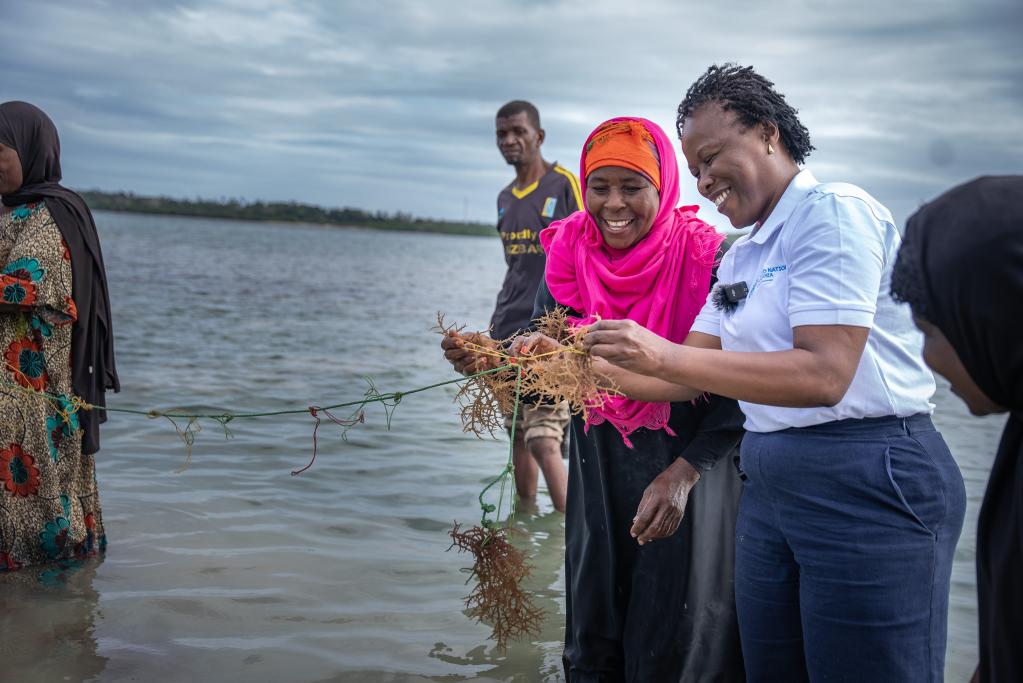
In her weathered hands, she carries bundles of rope that will soon become underwater gardens of hope. For Halima, like thousands of other women across Zanzibar's coastline, these submerged plots represent far more than agriculture, they are tickets to independence, education for her children, and dignity for her community."From this seaweed, I pay my children's school fees and provide food for my family," Halima explains, her fingers working with practiced precision as she ties delicate seaweed strands to cultivation ropes. "If we can grow our income, we can invest more in our homes and our community."Her story echoes across 23,000 farming families throughout this semi-autonomous archipelago, where over 80 percent of seaweed cultivators are women. What began as a humble coastal farming practice has blossomed into Tanzania's second-largest export crop, creating ripples of economic empowerment that extend far beyond the shoreline. More Than a CropSusan Ngongi Namondo discovered this shortly after arriving as UN Resident Coordinator in Tanzania. "It wasn't long after I arrived that I realized that seaweed is actually more than a crop here," she reflects. "Seaweed is a means of livelihood, sustaining families. Supporting women over generations."Walking through coastal villages where drying seaweed carpets the beaches in vibrant greens and browns, it becomes clear that this is not just farming, it is a lifeline. While the global seaweed market booms with demand for everything from food products to cosmetics, these women have been quietly perfecting their craft, generation by generation, in the crystal-clear waters off Africa's eastern coast.Yet despite their expertise and the growing international appetite for seaweed products, many farmers remain trapped in cycles of limited income. Without access to credit, insurance, or investment capital, their ability to scale up operations and tap into lucrative markets has been severely constrained.Breaking the BarriersThe breakthrough came when Zanzibar’s innovative approach caught international attention at the Local2030 Coalition and Joint SDG Fund Design Sprint in Bilbao, Spain. The idea of channelling integrated financial solutions into the seaweed value chain gained recognition and set the stage for a new joint programme.The Joint Programme on Transforming Seaweed Farming through Integrated Financial Solutions, funded by the UN Joint SDG Fund and implemented by FAO, UNDP, IFAD, and WFP in partnership with the Revolutionary Government of Zanzibar, targets one of the most critical bottlenecks in the sector: access to finance. By addressing credit, insurance, and cooperative-based financing, the programme will enable farmers—most of them women—to expand production, diversify products, and connect to new markets.For women who have never had collateral to offer banks or financial literacy training to navigate complex lending systems, this represents a shift. The initiative introduces de-risked lending schemes, microinsurance, and cooperative-based financing tools designed specifically for the realities of seaweed farming."The role of the UN is supporting women to scale up this business, to take seaweed and actually make it into a business," Namondo explains. "Seaweed is extremely lucrative right now, both as a food product and as a cosmetic product."By 2028, organizers aim to reach 15,000 households while raising incomes by 40 percent. But behind those statistics are individual dreams, children who will attend university, homes that will be improved, communities that will thrive.Building on strong foundationsThis new initiative complements the Zanzibar Joint Programme (ZJP): Integrated Innovations for Sustainable Development, co-designed by the Government and the UN with support from the Royal Norwegian Embassy in Tanzania. The ZJP addresses the root causes of poverty and inequality in two of Zanzibar’s most left behind regions through four transformative pathways, among them: enhancing seaweed production and quality, strengthening cooperatives, promoting gender equality, and improving post-harvest handling and market access. Together, the two programmes create a stronger ecosystem of support reflective of the Government’s wider blue economy strategy and its vision of seaweed as a driver of inclusive and sustainable growth. Looking aheadThe transformation happening in Zanzibar's seaweed sector reflects something larger, a recognition that sustainable development must be built on the foundations of what communities already do well. Rather than imposing external solutions, this approach amplifies existing expertise while removing systemic barriers."It's always good to be with farmers," Namondo muses after spending time in coastal communities. "I think farmers are among the happiest people on earth, and their work is shaping a better future for all of us."In the gentle ebb and flow of Zanzibar's tides, change is taking root. And for thousands of families across these islands, the future has never looked more promising.Note:All joint programmes of the Joint SDG Fund are led by UN Resident Coordinators and implemented by the agencies, funds and programmes of the United Nations development system. With sincere appreciation for the contributions from the European Union and Governments of Belgium, Denmark, Germany, Ireland, Italy, Luxembourg, Monaco, The Netherlands, Norway, Poland, Portugal, Republic of Korea, Saudi Arabia, Spain, Sweden, Switzerland and private sector funding partners, for a transformative movement towards achieving the SDGs by 2030.
1 of 5
Press Release
24 November 2025
MESSAGE ON THE INTERNATIONAL DAY OF PERSONS WITH DISABILITIES
People with disabilities are transforming societies — leading innovation, influencing policy, and mobilizing for justice. Yet too often, they are denied a seat at the decision-making table.The Doha Political Declaration, adopted at last month’s World Summit for Social Development, reaffirms a critical truth: there can be no sustainable development without the inclusion of people with disabilities.People with disabilities drive progress that benefits us all. Their leadership has improved disaster preparedness, expanded inclusive education and employment, and ensured humanitarian responses reach those most at risk.Many innovations that shape our daily lives — from text messaging to voice-activated technology — began as solutions developed by and for people with disabilities. Yet systemic barriers persist: discrimination, poverty, and inaccessible services continue to limit the participation of the over one billion people with disabilities worldwide.On this International Day of Persons with Disabilities, let us commit to working side-by-side with persons with disabilities in all their diversity, as equal partners.When inclusion is real, everyone benefits. Together, we can build more accessible, resilient societies where all of us thrive.
1 of 5
Press Release
31 October 2025
Statement attributable to the Spokesperson for the Secretary-General - on the United Republic of Tanzania
The Secretary-General is deeply concerned by the situation in the United Republic of Tanzania following the general elections of 29 October, including reports of deaths and injuries during demonstrations. He deplores the loss of life and extends his condolences to the families of the victims.He underscores the critical importance of safeguarding fundamental rights, notably the right of peaceful assembly and to freedom of expression including access to information. He calls for a thorough and impartial investigation into all allegations of excessive use of force.The Secretary-General is also deeply troubled by reports of enforced disappearances and detentions in the lead-up to the elections. He urges the authorities to ensure due process for all those detained, ensure their safety and security, and conduct thorough and impartial investigations into all allegations of human rights violations in line with international human rights standards.The Secretary-General calls on all stakeholders to exercise restraint, reject violence and engage in inclusive and constructive dialogue to address grievances and prevent further escalation. The United Nations stands ready to support efforts aimed at fostering dialogue, strengthening democratic governance and promoting sustainable peace in Tanzania. Stéphane Dujarric, Spokesman for the Secretary-General New York, 31 October 2025
1 of 5
Press Release
20 June 2025
European Union and UNHCR sign TZS 9.2 billion (EUR 3 million) agreement to strengthen protection and assistance to Congolese refugees and asylum seekers in Tanzania
The European Union (EU) and UNHCR, the UN Refugee Agency, have signed a new partnership agreement to continue providing protection and humanitarian assistance to Congolese refugees and asylum seekers residing in Nyarugusu Camp, as well as the new arrivals who are temporarily hosted at the Transit Centre in Kigoma Region, Tanzania. Through a contribution of TZS 9.2 billion (EUR 3 million), the EU will support UNHCR’s efforts to deliver timely, lifesaving, and protection-sensitive assistance and services in health, WASH, shelter, and education, including specialized services to persons with specific needs fleeing violence from the Democratic Republic of Congo (DRC). “The global increase in crises has led to an unprecedented number of refugees in urgent need of support around the world. That is why today I am proud to announce the signing of a 9.2 billion TZS (EUR 3 million), contract with UNHCR here in Tanzania. This crucial agreement will directly benefit refugees in Tanzania, ensuring their protection, enabling them to lead dignified lives, and supporting their access to livelihoods. As the European Union, we remain firmly committed to humanitarian values and international solidarity. We must continue working together to address these global challenges and uphold the rights and dignity of every individual seeking refuge,” says Ambassador Christine Grau, EU Ambassador to Tanzania and the East African Community.In 2025, UNHCR, in collaboration with national and international partners, continues to support the Government of the United Republic of Tanzania in receiving new arrivals in the Kigoma Region. From January to June this year, over 3,000 refugees have been received in Kigoma. UNHCR and partners continue to provide services to 85,105 Congolese refugees residing in Nyarugusu Camp. These individuals are provided with immediate life-saving assistance, including safe shelter, food, health services, clean water and sanitation facilities, and other essential support. Given the dire circumstances under which many refugees flee, often with only clothes on their backs and a few belongings, access to health, shelter, clean water, hygiene, and sanitation facilities is critical. These services not only reduce mortality and morbidity but also uphold the dignity, protection, and overall well-being of asylum seekers and refugees.“Standing with Congolese refugees and asylum seekers in Tanzania is not just our responsibility – it is a reflection of our shared humanity. Through the steadfast support of partners like the EU, we are not only meeting urgent needs, but investing in dignity, resilience, and the foundations of lasting peace for families who deserve hope and a future,” says Zulqarnain Hussain Anjum, UNHCR Representative a.i. in Tanzania.UNHCR requires an estimated USD 14 million (TZS 37.8 billion) to respond to the DRC emergency in Tanzania, including USD 5 million (TZS 13.5 billion) for preparedness, and appeals now more than ever for more humanitarian and international community support. As of 31 May 2025, Tanzania hosts over 230,000 refugees, mainly from Burundi and the DRC. ENDFor additional information: EU Delegation in Tanzania: Joseph Minde, Press and Information Officer, Joseph.MINDE@eeas.europa.eu UNHCR in Tanzania: Bahia Egeh, External Relations Officer, egehb@unhcr.org
1 of 5
Press Release
28 May 2025
UN Headquarters to Mark International Day of United Nations Peacekeepers on 29 May
In 1948, a historic decision was made to deploy military observers to the Middle East to supervise the implementation of the Israel-Arab Armistice Agreements, establishing what became the United Nations Truce Supervision Organization. Since that time, more than two million peacekeepers have served in 71 operations around the world. Today, approximately 68,000 women and men serve as military, police, and civilian personnel in 11 conflict zones across Africa, Asia, Europe, and the Middle East. A total of 119 countries currently contribute uniformed personnel.Tanzania is the 10th largest contributor of uniformed personnel to UN Peacekeeping. It currently deploys 1,548 military and police personnel, including 183 women, to the UN’s peacekeeping operations in Abyei, the Central African Republic, the Democratic Republic of the Congo, Lebanon, and South Sudan.During ceremonies at United Nations Headquarters, Secretary-General António Guterres will lay a wreath to honour the more than 4,400 UN peacekeepers who have lost their lives since 1948. He will also preside over a ceremony in the Trusteeship Council Chamber, where Dag Hammarskjöld Medals will be awarded posthumously to 57 military, police, and civilian peacekeepers who lost their lives serving under the UN flag last year. Among those to be honoured posthumously with the Dag Hammarskjöld Medal is Corporal Juma Ngai Kagose of Tanzania, who served with the UN Stabilization Mission in the Democratic Republic of the Congo (MONUSCO).The Secretary General will also present the 2024 Military Gender Advocate of the Year Award to Squadron Leader Sharon Mwinsote Syme from Ghana, and the UN Woman Police Officer of the Year Award to Superintendent Zainab Gbla of Sierra Leone. Both awardees currently serve with the United Nations Interim Security Force for Abyei (UNISFA).This year’s theme for the Day is “The Future of Peacekeeping.” The theme underscores what the ‘Pact for the Future’ adopted last year at the United Nations, including a commitment to adapt peacekeeping to a changing world, as expressed through Member States’ pledges to fill capability gaps and help UN peacekeeping respond to emerging challenges and new realities. This commitment was reiterated at the recent Peacekeeping Ministerial in Berlin.In his message, United Nations Secretary General António Guterres stated: “Today, peacekeepers face increasingly complex situations in an increasingly complex world... Now more than ever, the world needs the United Nations—and the United Nations needs peacekeeping that is fully equipped for today’s realities and tomorrow’s challenges.”“Today, we honour their service,” Mr. Guterres continued. “We draw inspiration from their resilience, dedication, and courage. And we remember all the brave women and men who made the ultimate sacrifice for peace. We will never forget them and we will carry their work forward.”Jean-Pierre Lacroix, Under-Secretary-General for Peace Operations, added: “Our personnel are our most important capability. The sacrifices made by our peacekeepers call for more than remembrance; they demand action. Throughout its history, peacekeeping has always adapted to ever-changing contexts to achieve results. The future of peacekeeping hinges on our collective commitment to continue to adapt and invest—so we can continue delivering hope and protection where it’s needed most.”The International Day of UN Peacekeepers was established by the UN General Assembly in 2002 to pay tribute to all men and women serving in peacekeeping and to honour the memory of those who have lost their lives in the cause of peace. # # # For media inquiries and further information, please contact: Department of Global Communications: Douglas Coffman: coffmand@un.org 1(917) 361-9923
1 of 5
Press Release
25 October 2024
UN, Govt Launch Data for Digital Agricultural Transformation Joint Programme
The Government of the United Republic of Tanzania and the United Nations officially launched a joint programme on (2024-27) that aims to harness digital technologies to transform Tanzania’s agricultural sector, improving productivity and resilience for rural communities, particularly women and youth. This USD 3 million initiative, which is supported by the European Union (EU) through the United Nations Joint SDG Fund, will implement digital platforms to provide real-time agricultural data, support smallholder farmers with better access to information, improve market access and enhance decision-making. The joint programme, under the overall leadership of the Ministry of Agriculture and the UN Resident Coordinator in Tanzania, will initially be rolled out in the regions of Dodoma, Kigoma, Ruvuma, and Manyara, targeting communities most in need of agricultural support, creating sustainable digital solutions, improving agricultural infrastructure, and fostering collaboration across sectors to transform agriculture. UNCDF (the lead UN agency for the programme), FAO, and IFAD will work closely with the Ministry of Agriculture, other key Government organizations and other stakeholders, to collectively drive the programme's success and achieve its objectives.
Highlighting the importance of leveraging partnerships to address agricultural challenges through innovative solutions, Head of the UN Resident Coordinator’s Office, Ms. Shabnam Mallick, stated: "This joint programme demonstrates the strength of the partnership between the United Nations and the Government of the United Republic of Tanzania. Together, with the generous support of the European Union and other contributors to the Joint SDG Fund, we are working towards empowering communities and decision-makers with the data and technologies needed to accelerate the sustainable development of the agricultural sector." Background Information:The Data for Digital Agricultural Transformation Joint Programme is funded by the United Nations Joint SDG Fund under the Digital High-Impact Track. It is a partnership between the Government of Tanzania and UN agencies, with the goal of accelerating the use of digital innovation to address agricultural challenges, boost productivity, and promote inclusive economic growth.This Joint Programme is made possible thanks to the generous contributions to the Joint SDG Fund from the European Union and the Governments of Belgium, Denmark, Germany, Ireland, Italy, Luxembourg, Monaco, the Netherlands, Norway, Poland, Portugal, Republic of Korea, Saudi Arabia, Spain, Sweden, and Switzerland. Their support is driving a transformative movement towards achieving the Sustainable Development Goals (SDGs) by 2030.
Highlighting the importance of leveraging partnerships to address agricultural challenges through innovative solutions, Head of the UN Resident Coordinator’s Office, Ms. Shabnam Mallick, stated: "This joint programme demonstrates the strength of the partnership between the United Nations and the Government of the United Republic of Tanzania. Together, with the generous support of the European Union and other contributors to the Joint SDG Fund, we are working towards empowering communities and decision-makers with the data and technologies needed to accelerate the sustainable development of the agricultural sector." Background Information:The Data for Digital Agricultural Transformation Joint Programme is funded by the United Nations Joint SDG Fund under the Digital High-Impact Track. It is a partnership between the Government of Tanzania and UN agencies, with the goal of accelerating the use of digital innovation to address agricultural challenges, boost productivity, and promote inclusive economic growth.This Joint Programme is made possible thanks to the generous contributions to the Joint SDG Fund from the European Union and the Governments of Belgium, Denmark, Germany, Ireland, Italy, Luxembourg, Monaco, the Netherlands, Norway, Poland, Portugal, Republic of Korea, Saudi Arabia, Spain, Sweden, and Switzerland. Their support is driving a transformative movement towards achieving the Sustainable Development Goals (SDGs) by 2030.
1 of 5
Latest Resources
1 / 11


Resources
02 September 2025


Resources
02 September 2025


Resources
16 August 2024


1 / 11
