
UN Secretary-General's remarks for the event, "Honouring Our Values at Home: Advancing Anti-Racism and Women's Rights in the United Nations"
"Numbers must translate into lived equality, lived rights and lived power."
Dear colleagues,
Throughout my life and public service, I have learned that confronting inequality and discrimination is about much more than addressing attitudes.
It is about the systems that determine who is heard and who is ignored; who is given opportunities and who is denied them; who shapes decisions and who must live with decisions made by others.
In other words, gender inequality is a question of power.
Racism is a question of power.
And power is never given, it’s taken.
That is why today’s theme, Honouring Our Values at Home, is so important.
The United Nations cannot credibly defend equality around the world unless we uphold it within our own walls.
Our values can’t live only in the words we address to others.
In 2020, the murder of George Floyd shocked the world.
It also compelled us to take a deeper look inward.
A Secretariat survey that year found that one in three staff members reported experiencing racial discrimination.
That is totally unacceptable.
It made clear that condemning racism was not enough.
We had to become actively anti-racist.
That is why we established the Task Force on Addressing Racism and Promoting Dignity for All.
We began conversations that had too often been avoided.
We developed a common language.
And we started building structures to turn awareness into action, including dialogues reaching tens of thousands of staff, mandatory learning, and voluntary race data collection.
We have moved forward.
But this is a long road.
The diversity of our organization is one of its greatest strengths.
Yet that diversity is not always reflected at every level.
All parts of the Organization must mirror the peoples we serve.
That means examining who exercises authority, whose expertise carries weight, who advances, and who remains held back by barriers that others may not see.
The same is true of gender parity.
We can now say with pride that the United Nations has achieved parity across all senior leadership, all headquarters and all professional staff.
We did this not by lowering standards, but increasing opportunities.
But parity is not the finish line.
Women must have equal opportunities to influence decisions, progress throughout their careers, and feel safe from danger and harassment.
Numbers must translate into lived equality, lived rights and lived power.
We must also recognize how race and gender intersect and shape the experiences of staff members in different ways.
Dear colleagues,
As we look ahead in this time of reform and financial pressure, we must not allow hard-won progress to be reversed.
Gender gains and expertise must be protected.
Anti-racism must remain a priority.
And decisions on recruitment, promotion, assignments and retention must be transparent, consistent and bias-free.
Policies matter.
And those policies make a difference far beyond our halls – better shaping the work we do to advance equality, take on discrimination, and deliver on the promise of opportunity for women and girls everywhere.
We must keep going:
By examining outcomes.
By listening to staff.
And holding leaders to account.
Dear colleagues,
Our Charter affirms the fundamental human right of equality for all women and men.
Yet across the world those rights are under threat.
We must push back against the pushback – starting at home.
And we must keep building an Organization in which power and opportunity are shared… where every colleague can contribute and lead… and where all of us can serve with respect and dignity.
Thank you.


Mtoa Hotuba
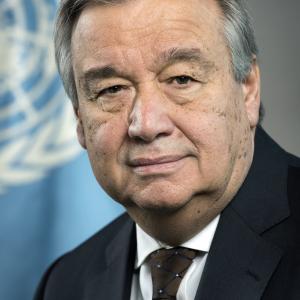
António Guterres
Malengo yanayofanyiwa kazi kupitia mpango huu


