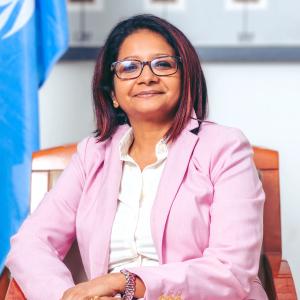
Opening Remarks by UNRCO Head of Office, Shabnam Mallick, TIMUN 2025 in Dodoma
Opening Remarks by UNRCO Head of Office, Shabnam Mallick
Hon. Cosato Chumi, Deputy Minister of Foreign Affairs and East African Cooperation
Senior Govt officials
2025 TIMUN Organizing Committee
Most importantly, this year’s Delegates and aspiring diplomats
Good Morning!
It is my great pleasure and honor to stand before you today at the official opening of the 2025 Tanzania International Model United Nations (TIMUN). I bring warm greetings from the entire UN family in Tanzania and express deep appreciation to the Youth of the United Nations Association (YUNA) for your leadership in cultivating a generation of globally conscious and civically engaged youth.
For nearly 30 years, TIMUN has served as more than just a conference—it has become a movement. A space where young people from across Tanzania and the world gather not only to simulate diplomacy but to sharpen their understanding of international cooperation, to debate ideas that shape our world, and to discover their own power to drive change.
This year’s theme, “Empowering Youth for a Sustainable Future: Digital Innovation,” could not be more timely. We are entering an era where artificial intelligence, digital automation, and emerging technologies are fundamentally reshaping the global economy.
You see, every generation has faced its share of challenges. You….the youth present here today…it looks to me to be Generation Z (or "Zoomers"): those generally born from the mid-to-late 1990s through the early 2010s. Your generations are the first ones in human history to have grown up with widespread access to the internet and mobile technology. In my generation, we were not born into a world where there were internet or computers. I can remember in our schools in India, the first where we could learn computers in schools was around when I was in the 9th or 10th grade. So…the challenges we faced in my generation were that we had to transition from analog to digital, from typewriters to computers and from landlines to smartphones. For some, this meant a steeper learning curve and a feeling of being left behind by the rapid pace of technological change. For your generation, artificial intelligence presents great opportunity and challenges. AI is transforming industries, redefining the nature of work, and challenging traditional pathways to employment.
Tanzania is laying important groundwork to integrate its youth into the digital economy. But ensuring equity, access, and opportunity—especially for rural and disadvantaged youth—requires continued investment in infrastructure, education reform, targeted training. No country can do this in isolation. It requires multilateral support.
Access to quality digital education, reliable internet connectivity, and opportunities to participate in the global digital economy are still uneven around the world. Without deliberate, inclusive policies, there is a real danger that millions of young people, especially in developing economies, may be left behind. Not because they lack talent or ambition—but because they lack access and opportunity.
This is where international cooperation becomes essential.
We need international cooperation to ensure that the benefits of AI and digital innovation are shared equitably. We need global norms to protect human rights in the age of algorithms. We need partnerships that empower Tanzanian youth with the skills, infrastructure, and platforms they need to thrive in a digital future.
That is why the United Nations is working to bridge this gap. Through the Youth2030 Strategy[1], the Global Digital Compact[2], and the outcomes of the Summit of the Future, we are building frameworks to ensure that technology serves humanity—not the other way around.
So, as you prepare to deliberate on issues like Zero Hunger, Gender Equality, Climate Action, Innovation, and Strong Institutions, know that you are engaging with the core of today’s global challenges. These are not just academic topics; they are the building blocks of a fair, peaceful, and sustainable world.
Let me share the words of Mwalimu Julius Nyerere, whose legacy continues to guide Tanzania’s engagement with the world. He once said:
“No nation has the right to make decisions for another nation; no people for another people.”
This is not only a call for national sovereignty. It is a timeless reminder of the values that underpin multilateralism: respect, equity, mutual dialogue and responsibility. It reminds us that in a world more connected than ever—technologically and economically—we must strengthen, not abandon, our commitment to global cooperation.
Here in Tanzania, I have seen youth already rising to this challenge. I’m made aware of young coders in Dar es Salaam building apps for social impact, young activists in Morogoro demanding environmental justice, and student diplomats—like you—negotiating with empathy, insight, and vision.
Let TIMUN 2025 be more than just a conference. Let it be a launchpad. A spark that ignites your ambition, refines your values, and connects you to a global community of change-makers. The United Nations is not a distant institution. It is your institution. And we stand beside you—as partners, as advocates, and as fellow dreamers.
Thank you, and I wish you all a powerful TIMUN 2025.
[1] The UN Youth Strategy, Youth2030, aims to empower young people to drive sustainable development and achieve the Sustainable Development Goals (SDGs) by 2030. It focuses on strengthening the UN's engagement with youth through two main pillars: Foundational Areas and Priority Areas. The strategy emphasizes youth engagement, participation, and advocacy, while also addressing critical areas like health, education, economic empowerment, human rights, and peace and resilience building.
[2] The Global Digital Compact, adopted at the UN's Summit of the Future, is a framework aiming to ensure a safe, inclusive, and human-rights-respecting digital future for all. It focuses on bridging the digital divide, fostering digital cooperation, and promoting responsible data governance and AI development. The compact commits member states to concrete actions like connecting the unconnected, making digital technologies accessible, and countering misinformation.


Mtoa Hotuba
Malengo yanayofanyiwa kazi kupitia mpango huu